Wednesday, June 16, 2010

Shop Found! Ibiz

Tucked away on a back alley near the bustling Campo de Fiori is a literal haven for purse junkies.


Confession: I am addicted to leather handbags. Can one ever have too many purses? I think not - and especially if they are as beautifully handcrafted as the bags at Ibiz in Rome.

Fulvio and Simonetta Nepi began making simple, Tolfa style leather bags back in the 70's. These bags were functional, utilitarian bags originally used by cacciatore (hunters) but the style caught on and soon everyone wanted this style of bag.


(one of Fulvio's original Tolfa bags, with leather stitching)

The demand was enormous - Fulvio sold his bags at the Porta Portese market, and on a table in Piazza Navona. At that time he was making the bags at home, even dying the leather with the help of his parents in their kitchen sink! He bought a used, foot-petal operated, sewing machine once owned by a Hollywood costume-maker who used it to stitch the costumes for Ben Hur! (The machine is still used in the shop today but now heavy cotton thread has replaced leather.)


In 1972, after returning to Rome from a trip to the island of Ibiza, Fulvio and Simonetta decided to rent a small storefront on the Via di Chiavari . What began as a hobby soon turned into a real business. Eventually they bought the storefront next door and continued to provide stylish Romans, as well as many tourists, with authentic Italian leather bags (and soon, leather chairs) made right on-site, in their workshop.

In 2001, business had slowed - Fulvio and Simonetta wanted to pursue different careers and they considered closing shop. But luckily, their daughter Elisa decided to take over and try to make a go of it. Elisa is a rare breed - she did not want to see the Italian tradition of hand made leather-craft lost. She explains that at one time Italy was known for its artisan leather shops. Italians were good at working with their hands. But the lure of big money was too strong and many Italians sold their shops, often to foreigners. Today Chinese imports flood the market and shops like Ibiz are few and far between.


The high quality leather and craftsmanship that were the hallmark of her father's original shop remain. Elisa and Fulvio (who is back working part-time at the shop) hand select the supple leather from the best tanneries in Tuscany. While the traditional bags and briefcases can still be found at Ibiz, Elisa is constantly on the look out for new trends and styles. The ideas are her own, the designs are original and unique ... although they are often quickly copied! What does she think about others copying her designs? She shrugs it off and says that is what keeps her creative, keeps her interested in the work - always looking for something new, something different.


In addition to the luscious, colorful assortment of leather purses and briefcases, she also designs belts, wallets and coin purses, and other small leather objects like fun key chains shaped like roses, tulips, or lilies (which are light, easy to pack, and make great gifts ...) Most recently she started designing colorful leather sandals.


Today Elisa reports that her main customers are tourists - not only from America, but many from Northern Europe, Japan, even Canada. Ibiz does not have a website, mail-orders are rarely taken, and they no longer do made-to-order bags (too costly). Elisa likes it that way - she maintains better control over the quality and quantity of her creations and she likes the face-to-face relationship she has with her customers. And I like it too! As if I need another reason/excuse/justification to buy a bag there, Elisa is incredibly generous and kind. I like what she stands for and I want her shop and others like it to succeed.

By the way, the bags are not only beautiful, but they are made to last - the first bag I bought from Elisa looks as good today as it did the day I bought it back in 2002. So, how many purses can one girl have? I will let you know when I get close.

LS

Tuesday, June 15, 2010

Leather Love

Do you love these:
Then you will love my post tomorrow - stay tuned!
LS

Monday, June 14, 2010

Products I Love: Roberts Acqua alle Rose

My good friend Erin Malone is responsible for my latest obsession - Manetti & Roberts Acqua alle Rose facial cleanser and skin toner. It was the packaging that initially caught her eye, and I have to say that one look at the cobalt blue bottle, old-timey label (not to mention the drug store pricing) and I was reeled in hook, line and sinker. Anything packaged that well had to be good, right? In this case, the answer is yes! And, even better, it is made in Italy.

It was way back in 1867 that Henry Roberts (an English chemist and pharmacist) created the facial tonic "Aqcua alle Rose" in his pharmacy on the elegant Via Tornabuoni in Florence. Supposedly this was the secret toner Florentine women could not live without! (However, it was Borotalco - a refined talcum power that would be his claim to fame and fortune.)


In 1992 the now Manetti & Roberts expanded the line of Acqua alle Rose products to include my beloved facial cleaner based on the original formula. The toner and cleanser contain no alcohol or colorants and are created with pure essential oil of Rosa Centifolia and distilled spring water so they are great for delicate skin. I was a little skeptical that the rose scent would be too much ... but the cleanser imparts only a gentle rose scent to the skin. What I like best is the fact that the products are incredibly light and leaves your skin feeling fresh, clean and luminous. Goodbye Kiehls - Hello Roberts!

Turns out the toner is also good for laundering lingerie and linens, and in the summer they recommend keeping the toner in the fridge and dabbing it on your face and body after a hot day in the sun (or out pounding the Roman cobblestones) for a refreshing, cooling sensation. I think I will definitely need to try that!

LS

Saturday, June 12, 2010

Found: Italian floor tiles


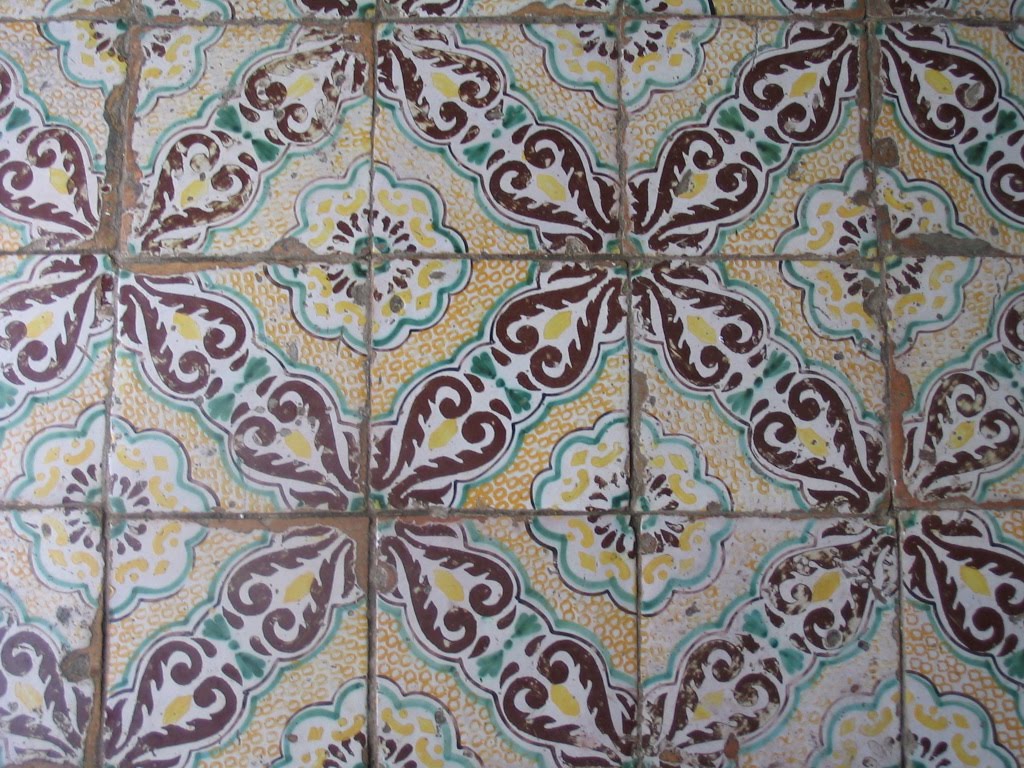
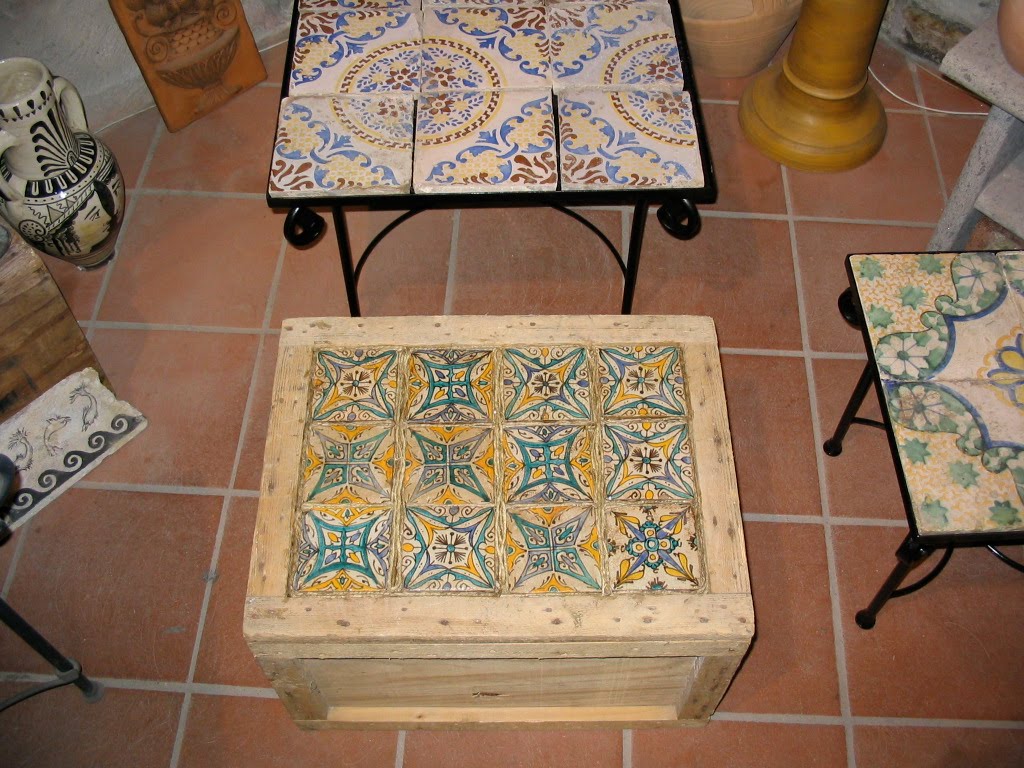
I love old Italian floor tiles. Every so often I find a few at the Porta Portese and lug them back to Seattle (here the key word is 'lug' as these tiles are really old, thick, and heavy.) I have amassed quite a stack over the years. I know what you are thinking - what on earth do I do with them? Well, I always thought that I would make a tabletop out of them, something like this:


But when I was down in Sorrento, my fabulous hotel, La Tonnarella, provided me all sorts of great new ideas. They have hundreds of these old tiles set in beautiful iron frames that they have hung all over the hotel:


Look how they have turned these old tiles into amazing planters:

Inspired, I did a little searching online and discovered a few more uses for these tiles. My new favorite reuse is as a colorful back splash:


Don't you think these would look great behind the sink or even the stove? I could also envision setting them into the terracotta tile in my studio/garden suite floor, imitating a big rug, similar to what they have done at this floral shop in Rome:


Or maybe I should create a stunning focal point in the yard, like this at the Agriturismo Seliano?


So many options! But I think I may need a few more tiles first!
LS

Intarsio di Sorrento

Sorrento is famous for its wooden mosaics. Surprised? Me too - so I decided to do some exploration into the traditional craft of marquetry, often referred to simply as 'inlay' (or intarsio, in Italian.)

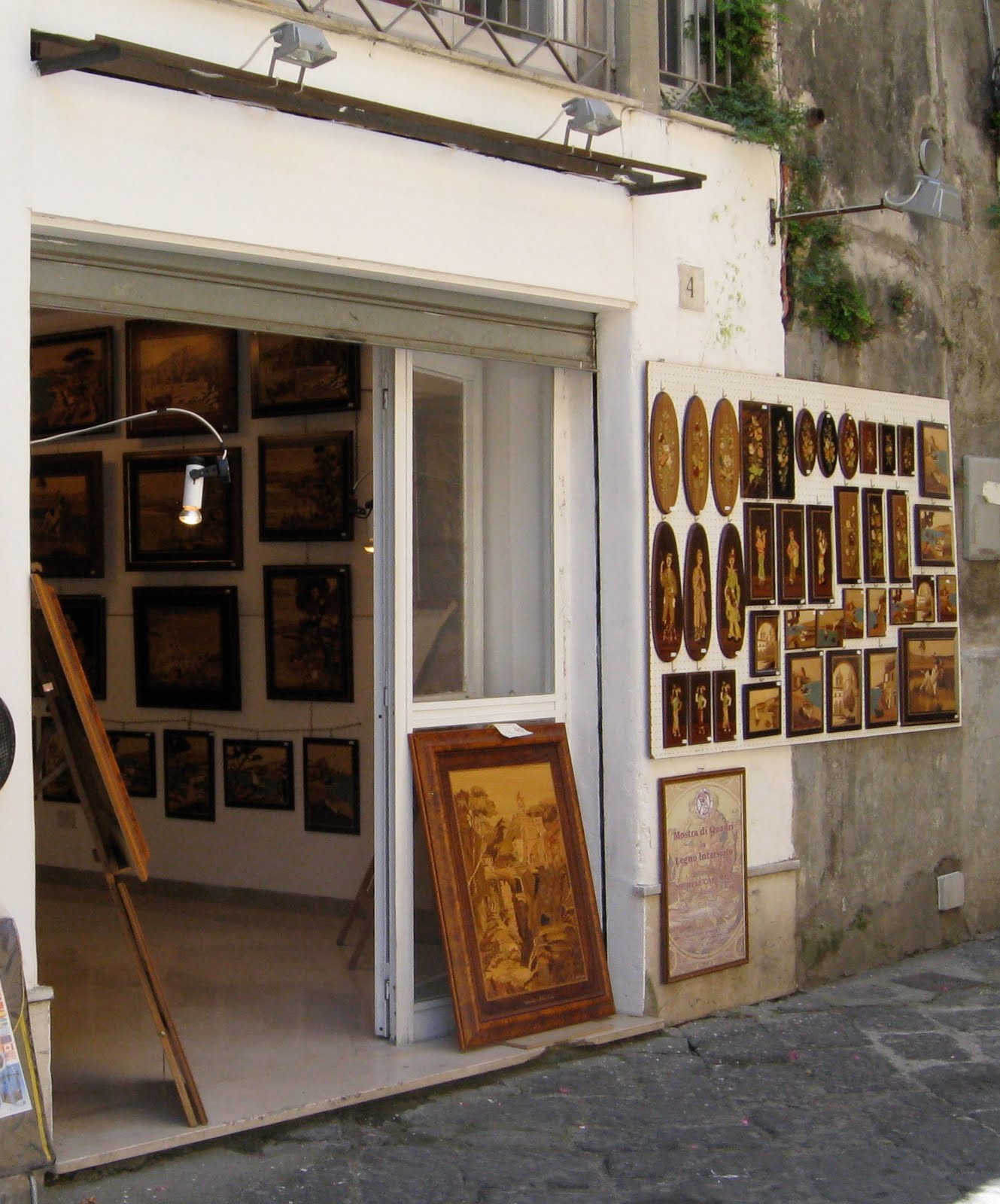
Strolling down the narrow backstreets of Sorrento's shopping district, one sees that the industry of marquetry is thriving here - shops are everywhere. Sorrento inlay work boasts unsurpassed quality, beauty and craftsmanship - it has even acquired its own descriptive title: Sorrento Ware and there is a museum in town dedicated to the history of the craft.


The art of intarsio is very old (there have been inlaid wood objects found in Turkey that date back to 350BC.) The tradition was mostly likely brought to Italy in the 15th century - first to Florence then, later, to Sorrento. Since the 19th century highly skilled Sorrento artisans have created a vast range of inlay works ranging from intricate jewelry and music boxes, chessboards and furniture, to the stunning wooden panels in the Sorrento Cathedral:


The technique of wood inlay is extremely delicate. First a drawing is made on a wooden veneer that acts template for the design. Shapes are painstakingly cut from various types of wood that determine the desired color, and then the pieces are shaped. The tessera are less thick than a millimeter thick! The pieces all resemble an intricate layered puzzle. After being cut they are shaded by immersion into hot sand.


Lastly, the wooden tessera are assembled and secured to the wooden surface, sanded and varnished. The final image is flush to the surface and glossy smooth. Every work is unique piece of art.


Unfortunately, the art of intarsio is suffering a fate similar to so many of these small, artisan traditions - it appears that young people are no longer interested in maintaining the craft. So, I say we better get out there and get those authentic Sorrento music boxes while we can! (I would be happy to go back to Sorrento and pick one out for you!)

LS

Paradise Found! La Tonnarella Sorrento

One of my favorite hotels on the planet is La Tonnarella in Sorrento. The grounds are lush and stunningly beautiful, the rooms are equipped with the essentails and comfortable (my room had a large bathtub and opened onto a garden!) The views down onto Sorrento and the bay of Naples from the hotels many terraces are breathtaking. Did I mention the private beach?? Well, there is a fantastic private beach and cafe that you can only reach by way of a ten story elevator down from the hotel.

I cannot wait to go back!! Check this OUT:


(yes, this is the elevator to the beach!)

LS

Sorrento!

Where have I been? Well, I spent the last week in beautiful Sorrento! I stayed here:


I ate lots of this:


and drank some of this:


I spent most of my time here:


and I did some research into this:


Stay tuned for more posts on my Sorrento adventures, coming soon!
LS

LinkWithin

Related Posts with Thumbnails